Download The Princeton Field Guide to Prehistoric Mammals (Princeton Field Guides), by Donald R. Prothero
Download The Princeton Field Guide to Prehistoric Mammals (Princeton Field Guides), by Donald R. Prothero
For more fascinating reason, you may unknown regarding the material of this publication, may you? Why do not you aim to understand? Recognizing new point will result in conceive the life better. You might not just review as the tasks, however analysis can be a way making your life run well. By this The Princeton Field Guide To Prehistoric Mammals (Princeton Field Guides), By Donald R. Prothero you could truly visualize exactly how the life will be and must be.
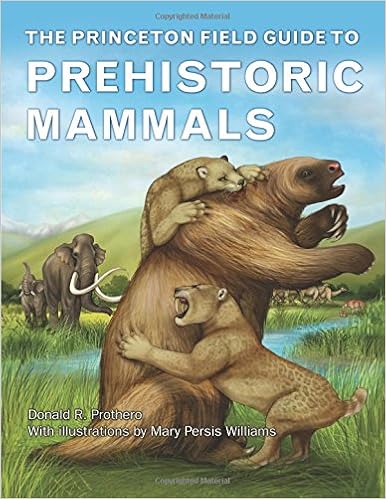
The Princeton Field Guide to Prehistoric Mammals (Princeton Field Guides), by Donald R. Prothero

Download The Princeton Field Guide to Prehistoric Mammals (Princeton Field Guides), by Donald R. Prothero
Staying in this brand-new period will certainly expect you to constantly compete with others. Among the modal to contend is the thought, mind, and also understanding consisted of experience that on by someone. To take care of this problem, everybody needs to have better expertise, minds, and also believed. It is to feel competed with the others, obviously in doing the generosity and this life to be better. One of the manner ins which can be done is by analysis.
Among referred reading books that we will certainly supply right here is The Princeton Field Guide To Prehistoric Mammals (Princeton Field Guides), By Donald R. Prothero This is a reading book, a publication as the others. Web page by web page is organized and also pilled for one. Yet, inside of every page had by the books consist of extremely amazing meaning. The significance is what you are currently seeking. Nonetheless, every publication has their features as well as significances. It will not depend on that check out but additionally the book.
By downloading this book soft data, you can begin reviewing The Princeton Field Guide To Prehistoric Mammals (Princeton Field Guides), By Donald R. Prothero from currently. It will certainly not compel you to always read it whenever. Juts utilize your spare time even couple of minutes. This is why when you intend to see exactly how the book material is offered; you have to read it from the front page. Yeah, invest your time to review it. This is our most recommended publication to check out when you wish to go with some journeys and holidays.
It will constantly be better to discover this book as well as other collections in this referred website. You may not need to get the book by strolling round your city and discover guide store. By visiting this website, you can find great deals of book from brochures to catalogues, from title to title and from writer to author. One to remember is that we additionally give remarkable publications from outside countries in this world. So, The Princeton Field Guide To Prehistoric Mammals (Princeton Field Guides), By Donald R. Prothero as one of the collections is really relied on the origins.
Review
"With a focus on the 66 million years since the end-Cretaceous extinction stripped away all dinosaurs but birds, Mr. Prothero's book ably demonstrates that mammalian evolution has been just as circuitous and strange as that of the terrible lizards. . . . [This book shows] the unexpected variety that life is capable of and raise[s] the question of what the next 235 million years will bring."---Brian Switek, Wall Street Journal"In The Princeton Field Guide to Prehistoric Mammals, author Donald Prothero . . . introduces readers to an array of real-life, but seemingly fantastic beasts--extinct mammals."---Mindy Weisberger, LiveScience"Written by American paleontologist Donald Prothero and beautifully illustrated by renowned scientific illustrator Mary Persis Williams, this publication is a 'must have' for academics and fans of fossils as well as anyone with an interest in general science. . . . Highly recommended." (Everything Dinosaur)"One of the most important things about this book is that it is fully up to date, and thus, the only current mammalian evolutionary overview that is available, to my knowledge. In some areas of fossil mammal research there has been a lot of work over recent years, so this is important. I highly recommend this excellent book." (Greg Laden's Blog)"Readable and highly informative. . . . I highly recommend this comprehensive and well-illustrated book to non-professionals with proficiency in paleontology and undergraduate students who are interested in the evolutionary history of animals. Furthermore, the book may be a handy guide for professional paleontologists involved in teaching."---Christine Böhmer, Journal of Paleontological Techniques"Due to Prothero's work with his vivid style of writing mentioning popular prehistoric mammal species (like the giant ground sloth Megatherium, the saber-toothed marsupial Thylacosmilus, or Steller's sea cow) and Williams' illustrations this prehistoric world is revived and reminds us how evolution has formed a breathtaking biodiversity of mammals."---Thiemo Braasch, Suiform Surroundings"The laudable efforts of Prothero to make prehistoric mammals shine in the shadow of the more popular dinosaurs lead to a book that will surprise and delight amateurs."---Jonathan J. Calede, Quarterly Review of Biology"The Princeton Field Guide to Prehistoric Mammals is a must-have for anyone interested in the fossil history of mammals, in part because works that review the whole of mammal history are otherwise virtually non-existent."---ScientificAmerican.com's Tetrapod Zoology blog, "Up-to-date, comprehensive, and very readable. Prothero is a renowned expert in this field, with decades of experience working on diverse groups of prehistoric mammals. He clearly knows his subject well and skillfully conveys this knowledge to readers."--Spencer G. Lucas, New Mexico Museum of Natural History and Science"Prothero knows his fossil mammals."--Christine M. Janis, coauthor of Vertebrate Life
Read more
From the Back Cover
"Up-to-date, comprehensive, and very readable. Prothero is a renowned expert in this field, with decades of experience working on diverse groups of prehistoric mammals. He clearly knows his subject well and skillfully conveys this knowledge to readers."--Spencer G. Lucas, New Mexico Museum of Natural History and Science"Prothero knows his fossil mammals."--Christine M. Janis, coauthor of Vertebrate Life
Read more
See all Editorial Reviews
Product details
Series: Princeton Field Guides (Book 112)
Hardcover: 240 pages
Publisher: Princeton University Press (December 6, 2016)
Language: English
ISBN-10: 9780691156828
ISBN-13: 978-0691156828
ASIN: 0691156824
Product Dimensions:
8.8 x 0.9 x 11 inches
Shipping Weight: 2.7 pounds (View shipping rates and policies)
Average Customer Review:
4.2 out of 5 stars
23 customer reviews
Amazon Best Sellers Rank:
#572,345 in Books (See Top 100 in Books)
Prehistoric mammals are not as fascinating to the public as dinosaurs, and we see many fewer popular books covering the topic. Two earlier attempts by professional paleontologists to cover the whole class that stick in my mind are “The Rise of the Mammals†by Michael Benton (1991) and “National Geographic Prehistoric Mammals†by Alan Turner (2004). The latter is memorable because it is illustrated by Mauricio Anton, whose work I greatly admire. In this tradition, but obviously much more up to date, is a new book “The Princeton Field Guide to Prehistoric Mammals†by Donald Prothero. Prothero works at the Natural History Museum of Los Angeles County. He has published a few dozen books on a diversity of biological topics (crytozoology, global warming, the fossil evidence for evolution, etc.).Just a few weeks ago I reviewed “The Princeton Field Guide to Dinosaurs (Second Edition)â€. This is an illustrated encyclopedia of individual dinosaur species, organized by phylogeny, plus some introductory material. I expected “The Princeton Field Guide to Prehistoric Mammals†to have a similar format. However, as the author explains in the Preface, while there are only several hundred valid dinosaur species, there are several thousand species of living mammals at least a few thousand extinct ones. So TPFGTPM is organized to highlight 15 mammal families, each in its separate chapter, with some of the more important genera emphasized. Aside from the details specific families, there are introductory chapters that include the synapsids (often called “mammal-like reptilesâ€) and mesozoic mammals (who were neither marsupials nor placental mammals). There is a closing chapter on mammal evolution and extinction.As mentioned above, the organization of the mammal families in this book is done phylogenetically. Some phylogenetic information is gotten by comparing the skeletal anatomy of the mammals (much as is done with dinosaurs), but since relatives of some extinct mammals are still alive, we can also compare DNA sequences. In some cases the anatomic and genetic information lead to different conclusions. Two interesting examples: There is a group of mammals called the Afrotheria, which have a common genetic signature, but do not resemble each other in any significant way: elephants, manatees, hyraxes, and elephant shrews. There is a genetic link between whales and hippos that shows they are more closely related to each other than to other artiodactyls (even-toed hoofed mammals). One consequence is that other artiodactyls once thought to be ancestral to whales, e.g. the wolf-like mesonychids, acquired some of their whale-like anatomical features through convergence.On that topic, many examples in TPFGTPM show that convergent evolution among mammal groups is extremely common, and the overall body form of mammals is dictated more by their “job†than by their ancestry. For example, there are many versions of the “wolf†(by which we mean a mid-sized pursuit predator) besides the canine version we have today. Most of us know about the “thalacyine (marsupial) wolf†which has been extinct only for decades. Not too many people are aware of the above-mentioned mesonychids (Paleocene through Eocene), which are artiodactyls. They strike us as very strange because there are no extant hoofed predators. There are also the “bear dogs†(Oligocene to Miocene) and creodonts (Eocene to Miocene). The same thing could be said about “lionsâ€, “cowsâ€, and “flying squirrels.â€One of the most interesting discussions in TPFGTPM is about extinct families that are poorly organized even now. One example is the uintatheres, the rhino- to elephant-sized herbivorous mammals with large tusks and large knobs on their heads. Much of the confusion in this group was brought about circa 1872 by the 19th Century rival paleontologists Edward Drinker Cope and O. C. Marsh. Each of these men named a large number of species in this group, sometimes naming the same animal twice, sometimes giving the different animals the same name, and always ignoring the names created by his rival. While dozens of names were proposed, a hundred years later only a handful are recognized as valid. Even now, though, it is not clear that all animals assigned to the uintatheres are actually related.TPFGTPM is very heavily illustrated, averaging one illustration per page. There are photographs of fossils, clear diagrams (most of which show phylogenetic relationships), and life restorations. The signature type of illustration for this book is the silhouette of a man surrounded by restorations of one to a dozen species in the specific family under discussion. Most of the life restorations are by Mary Persis Williams, who is a well-known scientific illustrator and blogger.In most book reviews I usually make a comment about the “sweet spot†for popular books on paleontology (or science in general). I hope a book will present enough technical material to make it interesting for a knowledgable amateur like myself, but not assume I am already aware of fiddly anatomical terms. Also, the more unfamiliar material the better. In TPFGTPM I encountered many families of fossil mammals I had never heard of before. TPFGTPM shows that prehistoric mammals are just as weird and fascinating as dinosaurs, and you should have it in your library.
I can see why other reviewers were critical of Mary Williams art,as it certainly was a huge waste of potential. If Mauricio Anton,or Peter Schouten illustrated this book it would be worth it's weight in gold. However the illustrations are by no means terrible,with the only reason for complaint being that they aren't photorealistic like the work of the other two artists I mentioned. Nevertheless,as I stated in the headline there's plenty of the latest discoveries and lots of great information. I really enjoyed it,and highly recommend this book to anyone interested in ancient mammals.
Mammals are one of the most interesting groups of vertebrates, with a very long history, with the first proto-mammals living towards end of Paleozoic. This book written for an authority show us a wonderful world of beasts many of them extinct but spectacular as dinosaurs. Many of the mammal lineages are treated and pictured with adequate artist renderings. A book for anyone interested in the evolution of animals in all biogeographic realms.
Purchased this wonderful book for my son and he loves it! It's incredibly informative and well illustrated! We're extremely happy with this wonderful book and I highly recommend it to anyone, child or adult who is interested in prehistoric mammals!
This is comprehensive, well organized and easy to read. The drawings are helpful, but not a fanciful as in some other publications.
It's astonishing that such a complete book, with attractive drawings, can be so inexpensive. This is an excellent companion to their field guide for dinosaurs.
Awesome book. My fourth grader loves it! He wants to be a paleobiologist when he grows up and this book definitely satisfies his craving for academic stimulation.
Terrific book. Best book I have ever seen or read on the prehistoric mammals of the Ice Age era. Very readable. Highly recommended !
The Princeton Field Guide to Prehistoric Mammals (Princeton Field Guides), by Donald R. Prothero PDF
The Princeton Field Guide to Prehistoric Mammals (Princeton Field Guides), by Donald R. Prothero EPub
The Princeton Field Guide to Prehistoric Mammals (Princeton Field Guides), by Donald R. Prothero Doc
The Princeton Field Guide to Prehistoric Mammals (Princeton Field Guides), by Donald R. Prothero iBooks
The Princeton Field Guide to Prehistoric Mammals (Princeton Field Guides), by Donald R. Prothero rtf
The Princeton Field Guide to Prehistoric Mammals (Princeton Field Guides), by Donald R. Prothero Mobipocket
The Princeton Field Guide to Prehistoric Mammals (Princeton Field Guides), by Donald R. Prothero Kindle
The Princeton Field Guide to Prehistoric Mammals (Princeton Field Guides), by Donald R. Prothero PDF
The Princeton Field Guide to Prehistoric Mammals (Princeton Field Guides), by Donald R. Prothero PDF
The Princeton Field Guide to Prehistoric Mammals (Princeton Field Guides), by Donald R. Prothero PDF
The Princeton Field Guide to Prehistoric Mammals (Princeton Field Guides), by Donald R. Prothero PDF


0 komentar: